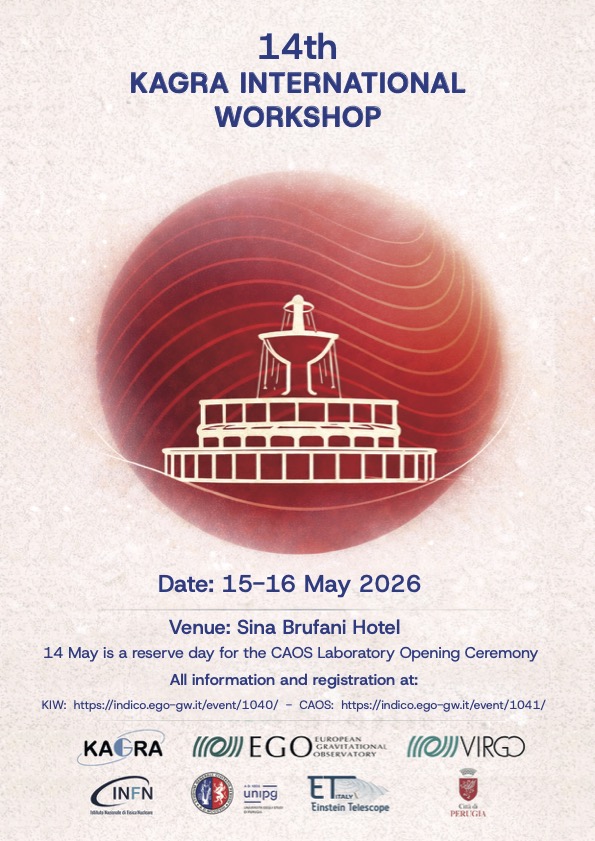
The 14th KAGRA International Workshop
Sina Brufani Hotel
Perugia - Italy
The 14th KAGRA International Workshop (KIW 14) will take place on 15–16 May 2026 in the Raffaello Room at the Sina Brufani Hotel, in Perugia
The KAGRA International Workshop focuses not only on the KAGRA project but also on the other gravitational wave detector experiments, gravitational wave sciences, and multi-messenger astronomy.
This workshop is open to all scientists who are interested in gravitational wave-related research and multi-messenger astronomy.
Back-to-back event
May 14th is reserved to the open ceremony of the CAOS International Laboratory. CAOS inauguration Indico website and registration.
Please beware of fake e-mails attempting to offer you to book accommodation. This meeting does not foresee any proceedings. Beware of phishing emails. The only reliable communications are those that come directly from the organisers.
![]() |
![]() |
![]() |
![]() |
![]() |
![]() |
![]() |
*Visa support
Please contact us if you need Visa support.
-
-
8:00 AM
→
9:00 AM
Registration 1h
-
9:00 AM
→
9:30 AM
Opening and Introduction
-
9:00 AM
Opening 10mSpeaker: Helios Vocca (Università di Perugia)
-
9:10 AM
Welcome talk 10mSpeaker: Patrizia Cenci (INFN Perugia)
-
9:20 AM
Welcome talk 10mSpeaker: Alessandro Paciaroni (Università di Perugia)
-
9:00 AM
-
9:30 AM
→
10:20 AM
The CAOS International Laboratory
-
9:30 AM
The CAOS Infrastructure: Full‑Scale Testing of Superattenuators for Future GW Detectors 20m
The CAOS Laboratory is one of the main research infrastructures of the PNRR‑ETIC project. The facility will host 15‑metre‑tall vacuum towers designed for the new generation of superattenuators, enabling full‑scale testing of solutions developed for the Einstein Telescope. Conceived as a technological “gym”, CAOS is an open and flexible environment made available to the wider gravitational‑wave community for the development, testing, and validation of advanced experimental concepts.
This contribution presents the laboratory and its distinctive features, which have been specifically designed to meet the requirements of experiments foreseeing a Fabry–Perot cavity aimed at testing key technologies for third‑generation gravitational‑wave interferometers. Particular emphasis is placed on the innovative superattenuator solutions that will be implemented as a first experimental step within the facility.Speaker: Francesco Bianchi -
9:50 AM
The CAOS towers 20m
The CAOS facility in Perugia is a dedicated laboratory for the testing and validation of mechanical and optical systems for the Einstein Telescope (ET). A key component of the facility is a seismically isolated Fabry–Perot cavity, designed to support advanced interferometric studies.
Within this framework, two 15-meter-high stainless steel towers have been installed. The towers are designed to operate under high-vacuum conditions (~10⁻⁷ mbar), imposing stringent requirements on materials, sealing, and contamination control. Building upon the heritage of the Virgo detector tower design, the structures have undergone extensive refinement through Finite Element (FE) analysis. These studies enabled optimization of the mechanical configuration under both static and dynamic loading conditions.
The design process focused on minimizing stress concentrations while ensuring adequate separation of mechanical resonance frequencies from operational bandwidths. Additional investigations addressed critical aspects such as airflow management to reduce mirror contamination during maintenance operations, the development of dedicated integration tools and procedures for lateral payload insertion at the tower base, and the assessment of Non-Evaporable Getter (NEG) pump performance within Super Attenuator environments.
This contribution presents the adopted mechanical solutions for the CAOS towers and provides an overview of the methodologies employed throughout the design and optimization phases.
Speaker: Prof. Aniello Grado (UniPG INFN-PG)
-
9:30 AM
-
10:20 AM
→
10:40 AM
Coffee break 20m
-
10:40 AM
→
11:30 AM
Kagra present statusConvener: Masaki Ando
-
10:40 AM
The Status of KAGRA 30m
KAGRA is a kilometer-scale cryogenic gravitational-wave detector located in Japan. From June 11 to November 18, 2026, KAGRA participated in the joint observing run (O4c) with all four sapphire mirrors cooled to below 100 K. KAGRA is currently working toward the sensitivity goals for the next short observing run (IR1) and the observing run 5. In this talk, lessons learned from O4c, the current status, and future plans for IR1 and O5 will be presented.
Speaker: Takafumi Ushiba (Institute for Cosmic Ray Research, The University of Tokyo)
-
10:40 AM
-
11:30 AM
→
1:00 PM
Other present and 3G detectors statusConvener: Takafumi Ushiba
-
11:30 AM
The Status of Virgo 20mSpeaker: Marie-Anne Bizouard
-
11:50 AM
The Status of LIGO 20m
-
12:10 PM
The Status of Einstein Telescope 20mSpeaker: Michele Punturo
-
12:30 PM
The Status of Cosmic Explorer 20mSpeaker: David H Shoemaker
-
11:30 AM
-
1:00 PM
→
2:30 PM
Lunch 1h 30m
-
2:30 PM
→
3:50 PM
InstrumentationConvener: Shinji MIYOKI
-
2:30 PM
Evaluation of the vibration noise for KAGRA detector 20m
KAGRA is a kilometer-scale gravitational-wave interferometer located in Japan. It has two unique features: a cryogenic environment and an underground site. KAGRA joined the O4c observing run in July 2026 with a binary neutron star merger range of 7.5 Mpc. In this talk, we present an evaluation of various environmental noise sources affecting the KAGRA detector, with a particular focus on vibrational noise. We also report measurements of the resonant frequencies of optics installed in the pre-stabilized laser (PSL) room, obtained through shaker injection and tapping tests.
Speaker: Takaaki Yokozawa (ICRR, University of Tokyo, Japan) -
2:50 PM
KAGRA Underground Environment: O4c and a Quiet Period 20m
We present a summary of environmental data measured in the KAGRA underground site during O4c, focusing on the period from June to November 2025. The data include seismic motion, acoustic noise, magnetic field, temperature, humidity, atmospheric pressure, and outside weather information. These measurements provide an overview of the underground environmental conditions relevant to KAGRA detector characterization and site studies.
We also analyze environmental data taken during an electrical facility inspection with a site-wide power outage in March 2026. This period offers a rare opportunity to study the underground environment under unusually quiet conditions. By comparing the power-outage period with normal operation, we evaluate changes in the environmental spectra and fluctuations in each channel and discuss contributions from facility operation and human activity.
These results provide a quantitative picture of the KAGRA underground environment during O4c and a reference for exceptionally quiet conditions, which will be useful for future environmental monitoring and detector characterization studies, such as the ET.
Speaker: Tatsuki Washimi (NAOJ) -
3:10 PM
Birefringence measurement and mitigation techniques 20m
KAGRA is the only gravitational wave detector operating with crystalline test-masses at cryogenic temperature. While this allow to reduce the thermal noise of the detector, this comes at the expense of operating with complex test-masses. One issue, is the birefringence of these test-masses that can spoil the detector sensitivity.
In this talk, we will report about the techniques developed to measure the birefringence of large sapphire substrates forming KAGRA test-masses as well as the birefringence mitigation and compensation techniques being currently developed towards a possible installation in KAGRA
Speaker: Marc Eisenmann (NAOJ) -
3:30 PM
Environmental Noise Studies for Virgo during the O4 Observing Run 20m
On behalf of the Virgo Collaboration, we present the main environmental noise studies carried out at Virgo in-preparation, during, and after the O4 observing run. These studies aimed at characterising the interferometer environment and assessing the coupling of external disturbances to detector sensitivity. We focus in particular on the impact of wind, on magnetic and vibro-acoustic noise coupling measurements, and on mitigation actions applied to infrastructure devices. The results contribute to improving detector robustness and informing future observing runs.
Speaker: Irene Fiori (European Gravitational Observatory)
-
2:30 PM
-
3:50 PM
→
4:10 PM
Coffe break 20m
-
4:10 PM
→
5:30 PM
Instrumentation
-
4:10 PM
Alignment sensing and control using Wave Front Sensing demodulated at the difference frequency between two phase-modulation sidebands in KAGRA 20m
Alignment sensing and control are essential for maintaining the stability of laser interferometric gravitational-wave detectors. Wavefront sensing (WFS) is an effective technique for detecting the misalignment between the cavity axis and the incident beam axis. However, the conventional WFS, which relies on the beat between the carrier and phase-modulated (PM) sidebands, is dominated by arm cavity-axis signals when the carrier resonates in the full interferometer. This dominance limits the sensing of other optical axes.
In this presentation, we propose a new sensing technique that demodulates the beat signal at the difference frequency between two anti-resonant PM sidebands. We present its theoretical response and present experimental results using the power-recycled X-arm configuration of KAGRA.Speaker: Chiaki Hirose (Institute for Cosmic Ray Research, The University of Tokyo) -
4:30 PM
Status and Plans of KAGRA Squeezing subsystem 20m
Among various upgrade options, high-frequency (kHz) sensitivity is one of the candidates for KAGRA upgrade. With the cryogenic systems, and there is almost no mysterious noises in high-frequency, the Only limitation is the shot noise. In this talk, I will report the status about vOPO (vacuum optical parametric oscillator) test in NAOJ, with preliminarily 7 dB Squeezing (at 2.5 MHz) and nearly 8 dB SQZ (at 100 kHz). Our plans to install KAGRA SQZ Subsystem will also be reported.
Speaker: Prof. Ray-Kuang Lee (NTHU) -
4:50 PM
Cryogenic Suspension Development at the Glasgow Cryogenic Interferometer Facility 20m
The Glasgow Cryogenic Interferometer Facility aims to advance cryogenic gravitational-wave detection technologies, informing the development of future observatories such as the Einstein Telescope. The research programme includes the demonstration of fully crystalline cryogenic suspension system, which entails the characterisation of crystalline silicon and sapphire suspension elements, alongside optical studies of silicon test masses. Suspension materials must exhibit low mechanical loss, high thermal conductivity, sufficient tensile strength, and suitable optical properties to avoid limiting thermal noise performance.
In collaboration with researchers from KAGRA, low-Q measurements of sapphire suspensions are being investigated through finite element analysis, including modelling of laser-welded and polished sapphire fibres. We report recent progress in sapphire fibre fabrication and jointing techniques, together with updated experimental characterisation results. These developments contribute to the development of realistic thermal noise models for both sapphire and silicon suspensions.Speaker: Ardiana Nela on behalf of the Institute for Gravitational Research -
5:10 PM
Impact of ITM Birefringence on Future Squeezed-Light Operation in KAGRA 20m
Squeezed vacuum injection is one of the key upgrades for improving the high-frequency sensitivity of KAGRA. However, the inhomogeneous birefringence of the sapphire input test masses (ITMs) can limit the achievable squeezing benefit. In this work, we evaluate how the measured ITM birefringence affects squeezed-light operation in KAGRA.
The ITM birefringence couples the fundamental interferometer mode, S-polarized HG00, into P polarization and higher-order spatial modes. These components should not be treated only as lost fields. After propagating through the interferometer, they acquire different phase rotations through Gouy phase evolution and polarization-dependent beam-splitter reflection phases, and can coherently recouple to the fundamental mode. This recombination mixes anti-squeezed noise into the detected squeezed quadrature.
Using a mixing model that includes HOMs, S/P polarization, and the asymmetry of the two KAGRA arms, we find that the present ITM birefringence can strongly suppress the squeezing gain. For 10 dB input squeezing, the high-frequency sensitivity can become worse than the unsqueezed case in part of the band. We also investigate how the degradation changes when the birefringence strength and injected squeezing level are varied, and discuss the implications for allowable ITM birefringence and future squeezed-light commissioning in KAGRA.
Speaker: Yuheng Ye (The University of Tokyo)
-
4:10 PM
-
5:30 PM
→
7:00 PM
Poster sessionConvener: Helios Vocca (Università di Perugia)
-
8:00 PM
→
11:00 PM
Social Dinner 3h
-
8:00 AM
→
9:00 AM
-
-
9:00 AM
→
10:00 AM
Modelling and Data Analysis
-
9:00 AM
Numerical modeling of quantum noise in gravitational wave detectors 20m
This project simulates the quantum noise of gravitational wave interferometric detectors in different configurations: no squeezing injection, frequency independent squeezing and frequency dependent squeezing (with filter cavity). Key features: implementation of substrate losses, intra-cavity arm losses and EPR squeezing injection.
Speaker: Greta Tosti -
9:20 AM
Modeling of a seismic attenuation system for gravitational wave detectors 20m
In this project will be presented the implementation of deep reinforcement learning for seismic noise attenuation in gravitational-wave detectors.
From the creation of the envirorment to the training of agents for the stabilization of mirror.Speaker: Alessandro Kotchian (INFN Perugia, Univ. Perugia) -
9:40 AM
Differentiable programming for experiment design optimization in precision physics experiments 20m
Quantum noise reduction techniques are key to improving gravitational-wave detector sensitivity, yet their design involves tightly coupled parameters typically tuned via skilled human designer.
We propose an end-to-end differentiable programming framework in which the quantum noise reduction chain is modelled as a parametrized simulator, enabling direct computation of gradients of performance metrics (e.g., strain sensitivity) with respect to physical parameters via automatic differentiation. This transforms detector design to a gradient-based optimization problem.
Speaker: Mateusz Bawaj (University of Perugia)
-
9:00 AM
-
10:00 AM
→
10:40 AM
Multi-messengerConvener: Michele Punturo
-
10:00 AM
Gravitational responses of compact stars with analytic equations of state 20m
We apply analytical models to study the property of neutron stars and dark stars. With the aim of exploring the global observable properties of those compact stars, we investigate the total masses and radii, the tidal deformabilities and especially the fundamental (f -) mode oscillations. While we choose two typical models in this work, this method applies to any analytical equations of state. By comparing with the multi-messenger observations, one can constrain the corresponding parameters in those models.
Speaker: Alessandro Parisi (Università di Perugia) -
10:20 AM
Study of Multimessenger Science Scenarios with CTAO and Gravitational Wave Interferometers 20m
The detection of the gravitational-wave event GW170817 by the LIGO–Virgo–KAGRA Collaboration in 2017 demonstrated the feasibility of a multimessenger approach combining gravitational waves and electromagnetic counterparts produced during compact binary coalescences, such as binary neutron star (BNS) mergers and neutron star–black hole (NSBH) mergers. However, observations since 2017 have shown that these astrophysical events are relatively rare, and that detecting both the gravitational and electromagnetic signals with current instruments remains challenging.
The aim of this project is to investigate BNS and NSBH events in both the near and long-term future, in order to understand the role they will play with the upcoming upgrades of gravitational-wave detectors and the development of next-generation facilities. On the gravitational-wave side, we consider the future upgrades of the LIGO–Virgo–KAGRA (LVK) network as well as next-generation interferometers such as the Einstein Telescope and Cosmic Explorer. For the electromagnetic counterpart, we focus on the very-high-energy component of the afterglow emission associated with gamma-ray bursts produced during the merger. In particular, we explore the detection capabilities of the Cherenkov Telescope Array Observatory, which is currently under construction.
To estimate the expected number of multimessenger detections in this framework and to assess how joint observations can constrain the physical properties of the merger, we are developing a numerical code to compute the synchrotron self-Compton emission of the afterglow. The model incorporates a structured jet profile, allowing us to account for both on-axis and off-axis observations of gamma-ray burst emission.Speaker: Tobia Matcovich (Università di Perugia, I-06123 Perugia, Italy)
-
10:00 AM
-
10:40 AM
→
11:00 AM
Coffee break 20m
-
11:00 AM
→
1:20 PM
KAGRA R&DConvener: Takayuki Tomaru
-
11:00 AM
Quantum noise reduction schemes for KAGRA post-O5 20m
Quantum noise has been the limiting noise at high frequency and a relevant noise at low frequency for the sensitivity of current gravitational wave detectors. It is also expected to be a limiting noise source for future interferometric gravitational wave detectors across the whole frequency band. Squeezed vacuum has become a standard tool for reducing quantum noise and led to up to 65\% increase of detection rate for current gravitational wave detectors. To reduce quantum noise over a broad frequency band, current solution is to combine squeezed vacuum with a hundred-meter long, detuned, and over-coupled optical cavity, usually called filter cavity. However, there are many other quantum noise reduction techniques. For certain cases, the noise limitation from other noise sources is relatively high at low frequency, which makes the consideration of various quantum noise reduction technique necessary. In the context of KAGRA post O5, we have compared quantum noise reduction schemes, including single-mode squeezing technique (frequency independent squeezing, frequency dependent squeezing with filter cavity or amplitude filter cavity or frequency dependent beam splitter) and two-mode squeezing technique (EPR scheme). We find that the behavior of suspension thermal noise and mirror thermal noise plays crucial role for deciding which quantum noise reduction scheme is more suitable. We also analyzed the difference of filter cavity and EPR scheme when the losses and length of the filter cavity is varied.
Speaker: Yuhang Zhao (Henan Academy of Sciences) -
11:20 AM
Reducing Suspension Thermal Noise in KAGRA 20m
Improving thermal noise in the cryogenic sapphire suspension is one of the key factors for further enhancing the sensitivity of KAGRA.
In this presentation, the contribution of thermal noise from each component of the cryogenic sapphire suspension to the KAGRA sensitivity is first described.
Efforts to reduce thermal noise in the cryogenic sapphire suspension are then presented, focusing on improvements in the quality factors (Q factors) of sapphire fibers and blade springs. For sapphire fibers, improvements through bonding, polishing, and Sumiceram treatment, among others, are presented, while for blade springs, optimization of their geometry is discussed.
Speaker: Munetake Otsuka -
11:40 AM
A fiber optic continuos strain sensing plant for CAOS in Perugia 20m
The construction of CAOS in Perugia allowed to insert optical fibers embedded in the building to measure local strain with spatial resolution. This will be measured by means of a Distributed Acoustic Sensing interrogator Silixa Carina, with nominal spatial resolution down to a quarter of a meter. We report about the plant installation.
Speaker: Piero Chessa (University of Perugia) -
12:00 PM
Mechanical tests on silicon fibers 20m
To build suspensions for the main optics of 3G gravitational wave interferometers that will operate at cryogenic temperatures, one must consider the triple roles that the system plays: suspend 200kg mirrors, cool them and ensure the lowest possible thermal noise. In this talk, we will present the results of the latest mechanical tests performed on silicon fibers to understand what is the state of the art based on the minimum requirements for a cryogenic suspension for ET.
Speaker: Michele Arcangelo Dicorato -
12:20 PM
FLECS: a finite elements simulation tool for prototyping GAS spring blades 20m
FLECS (Flexible Linear Elements Connected in Series) is a finite elements simulation code under construction that simulates the static and dynamic behavior of spring blades in a geometric anti-spring (GAS) configuration. In this talk insights of the working principles of the code and some potential outcomes will be discussed, along with a description of the experiment designed to provide experimental validation of the simulation tool.
Speaker: Nicolo Baldicchi (Università degli studi di Perugia) -
12:40 PM
Fast Time-Domain Simulation of Fabry–Pérot Cavities for Reinforcement Learning-Based Lock Acquisition 20m
We present a fast time-domain simulator designed to reproduce the dynamical behavior of Fabry–Pérot cavities. The simulator implements a recursive field propagation formalism that explicitly accounts for multiple round trips within the cavity, enabling accurate modeling of transient phenomena such as ring-down, during resonance crossings. It supports step by step dynamic mirror motion and assures high computational efficiency.
A key feature of the framework is its integration with reinforcement learning environments, enabling the development and benchmarking of advanced control strategies for cavity lock acquisition. In particular, the tool has been already used to train deep reinforcement learning agents to stabilize cavities under nonlinear conditions where traditional linear control methods are less effective. Moreover, different configurations, such as multiple cavities in cascade, could be implemented thanks to the modular architecture, making it a valuable tool for simulating physically interesting scenarios. This framework finds a natural application in next-generation gravitational-wave detectors, where lock acquisition remains particularly challenging due to strong nonlinear dynamics and transient effects in high-finesse optical cavities.Speaker: Andrea Svizzeretto -
1:00 PM
Magnetically levitated massive resonators for quantum sensing 20m
Levitated mechanical resonators have the potential to achieve low mechanical loss and high quality factor (Q factor), which is critical for many applications, e.g. high precision sensors, and exploring fundamental quantum physics. Diamagnetic levitation is a promising technique, which requires no energy input and can trap massive objects. However, conductive pyrolytic graphite, one of the strongest room-temperature diamagnetic materials, suffers severe eddy damping, leading to a very low Q factor. We explored different methods to increase the Q factor to satisfy a variety of applications. Firstly, we cut slots into the graphite plate to interrupt the eddy currents and the Q is increased by a factor of ∼ 40 while keeping the integrity of the plate itself.[1] In the second method, we make insulating composites by blending the insulating-coated graphite powders with vacuum-compatible wax. The cm-sized composite resonators achieve motional Q factor at the scale of 10^5.[2] We also cool the center-of-mass motion of the composite resonator by 3 orders of magnitude, using feedbacak method. In addition, we propose a cavity optomechanical system to reach the quantum ground state of a magnetically levitated mirror, by locking it to a fixed fiber Bragg mirror , using the Pound-Drever-Hall (PDH) technique.[3] These will enable us to engineer macroscopic superposition states to study quantum gravity and build ultra-precise accelerators.
1 P. Romagnoli et al., Appl. Phys. Lett. 122, 094102 (2023)
2 S. Tian et al., Appl. Phys. Lett. 124, 124002 (2024)
3 A. Hodges et al., Phys. Rev. A 113, 033508 (2026)Speaker: Shilu Tian (Institute of Science Tokyo)
-
11:00 AM
-
1:20 PM
→
2:50 PM
Lunch 1h 30m
-
2:50 PM
→
3:00 PM
Group picture 10m
-
7:55 PM
→
9:55 PM
Social Event
-
9:00 AM
→
10:00 AM